
“Public art engages social interaction – both during the selection process and following installation…An artwork can lead the viewer toward self-reflection and awareness.”
Renowned sculptor and public installation artist, Maggie Otieno, is celebrating every win. She points out the growing realization that there should be more public art expressions in spaces around Nairobi.
Speaking during The GoDown’s 3rd Urban Dialogue addressing Culture and Sustainable Urban Development a fortnight ago, Maggie’s enthusiasm and passion for her craft were met with a healthy dose of optimism about the uptake of public art in the city. As a practitioner for the past 26 years, her optimism is a welcome relief.

[ Left: Last of the Keep by Maggie Otieno. Location: Tafaria Castle and Centre for the Arts, Nyeri]
Her artwork graces a range of locations in the city and many beyond. In Nairobi, you will find her sculptures at Imara Daima and Makadara Railway Stations, as well as Garden City Mall in Ruaraka.
“Public art,” Maggie says, “is especially fulfilling to the artist. When you create a piece of work for an individual, he or she will enjoy it alone in the comfort of their home. And that’s ok. But public art is a joy because a multitude of people get to enjoy it. There is something you’re saying, and many people you are saying it to.”

Her piece [above] located at the Syokimau Railway Station, tells the story of the Prophetess after whom the area is named. In the work, Syokimau symbolically points to the sky foretelling that the white man would come riding on a metal snake with smoke coming out of it. “So many people don’t know that story. The work keeps the story and our history alive.”
The artist defies convention in many ways. Donning her overalls, Maggie will be found at her workshop welding automotive spare parts, different sizes of scraps of metal and working with railway sleepers to create her artwork. Through the recycled material, she says and we can attest, the artwork carries a rich tapestry of stories.
It is no coincidence, then, that a lot of her work is installed at transport hubs. Spaces traversed by thousands of city residents daily. In addition to the Syokimau Railway Station, you will find her sculptures at the Imara Daima and Makadara Railway Stations too.

The Makadara Railway Station is the home of her sculpture of the labour union organizer and legendary national leader, Tom J. Mboya. [Left] The station is a short distance away from the Social Hall which bears his name and which was the birthplace of the Kenyan labour movement.
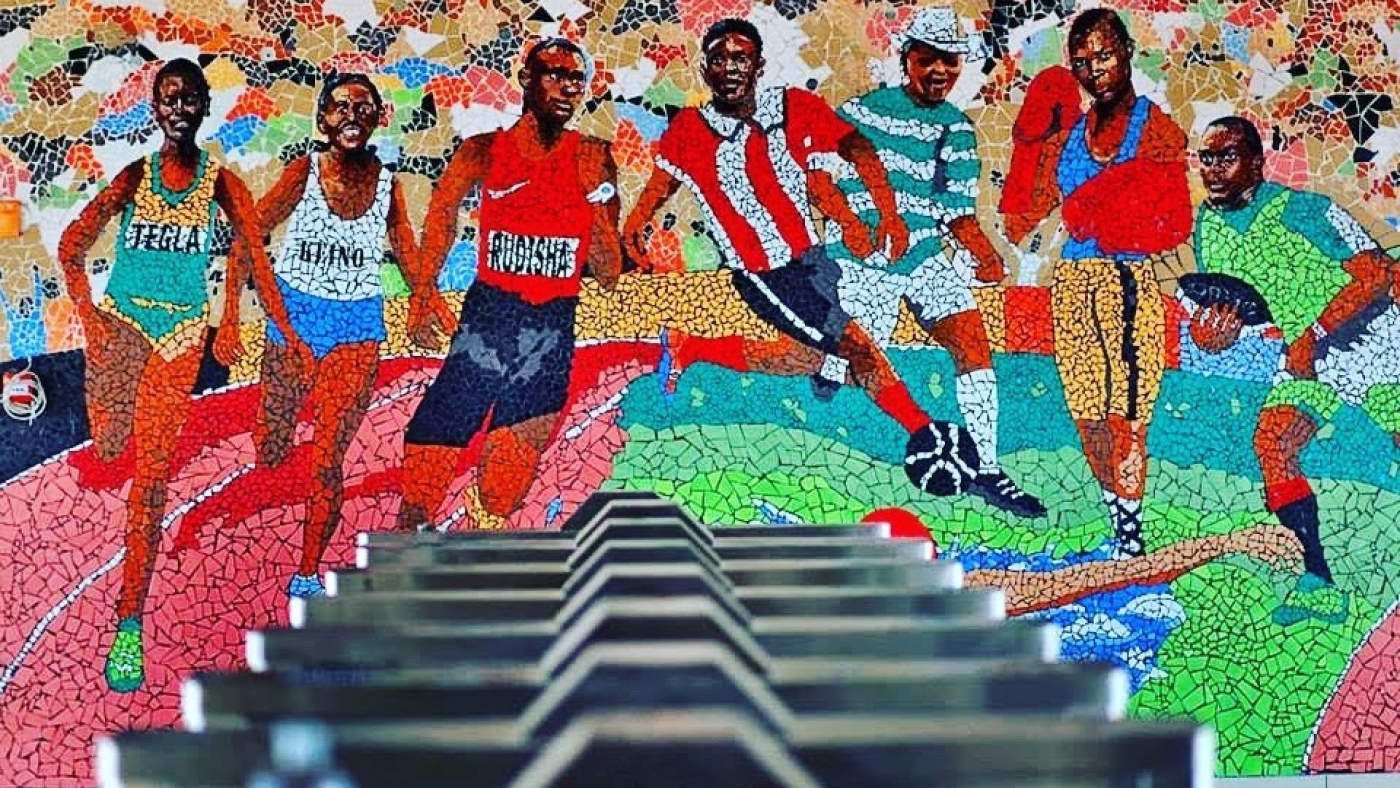
Her work at the Imara Daima Railway Station consists of sculptures and a mural of Kenyan athletes, a tribute which is relatable and a source of immense national pride.
“Cities gain value through public art – cultural, social, and economic value. Public art is a distinguishing part of our public history and our evolving culture. It reflects and reveals our society, adds meaning to our cities and uniqueness to our communities.
Public art humanizes the built environment and invigorates public space. It provides an intersection between past, present and future, between disciplines, and between ideas. Public art is freely accessible.” Americans for the Arts: Public Art Network Council Green Paper
The Garden City Mall is home to her famous “Gatekeepers”, a series of sculptures which provide a popular backdrop for the many grinning selfies, but also the subject of a great deal of enquiries. Maggie tells the story of when she was installing the pieces, passersby were curious.

One asked whether the pieces could move. ‘Since they are made of automotive spare parts,” one onlooker asserted, “of course they should move.” “Is that supposed to be a person?”, another asked, “mimi sioni hio!” (I can’t see that!) In addition to situating a community and recounting history, public art evokes conversations and elicits questions fostering a true sense of agency.
[Left: The Gatekeepers at The Garden City Mall, Nairobi]
People interacting with public art receive relief from the daily humdrum and are provoked to imagine a future for themselves and their community.

[The artist with her mural of athletes located at Imara Daima Railway Station]